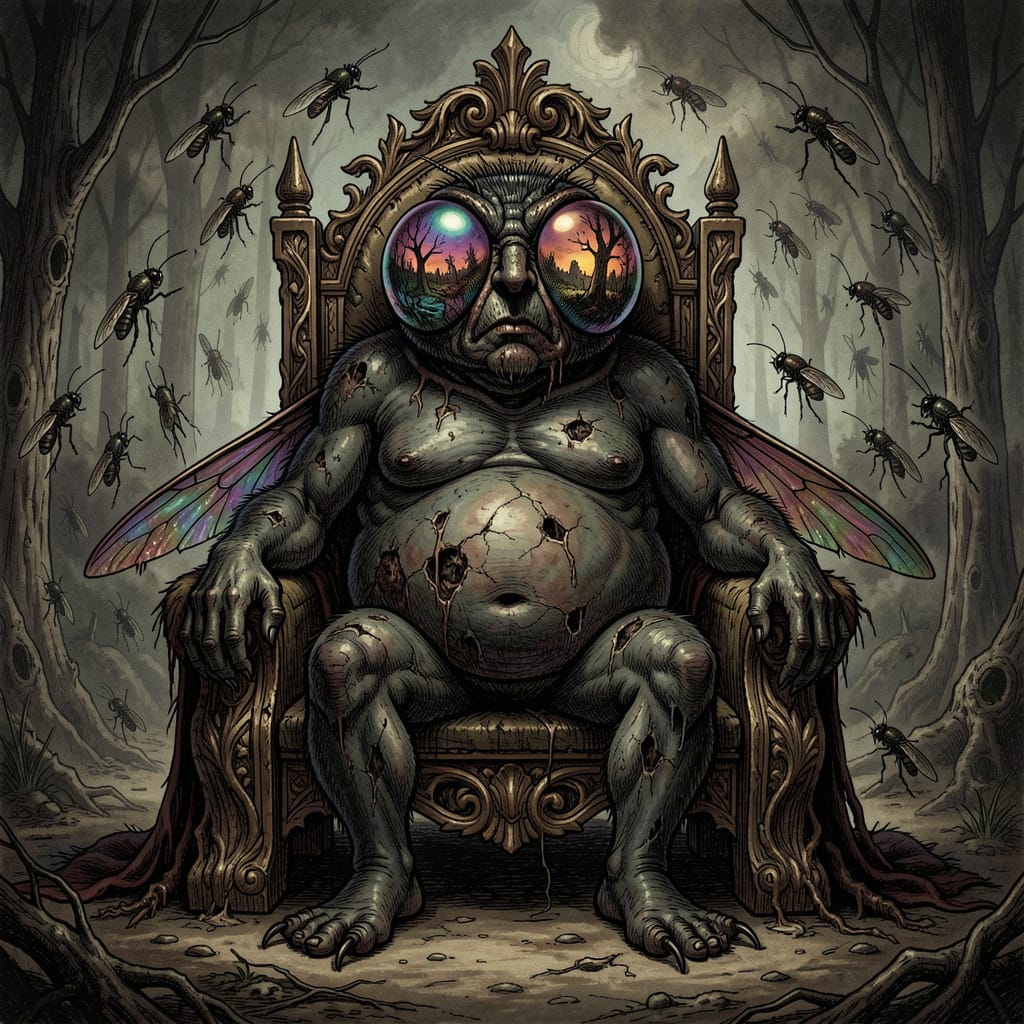
The name first appears in 2 Kings 1, when Ahaziah, king of Israel, injured in a fall, sends messengers to consult Baal-Zebub, the god of Ekron, to learn whether he will recover. The prophet Elijah intercepts them: "Is it because there is no God in Israel that you are going to consult Baal-Zebub, the god of Ekron?" — and pronounces the king's death for the idolatry. Here Beelzebub is a rival deity, a false god set against Yahweh, and his defeat is the defeat of the foreign cult.
By the New Testament, Beelzebub has become the name for the prince of demons himself. In Matthew, Mark, and Luke the Pharisees accuse Jesus of driving out demons "by Beelzebub, the prince of demons" — and the accusation, in the logic of the text, is also a naming of the highest demonic authority. Whether they mean Satan or a distinct figure is left theologically unresolved; Jesus' reply disputes the method, not the hierarchy. The Testament of Solomon has Beelzeboul confess that he was once a leading heavenly angel, associated with the evening star, and that he now works destruction through tyrants, incites the worship of demons, and stirs jealousy, murder, and war.
In John Milton's Paradise Lost, Beelzebub is Satan's second-in-command — the first named among the fallen after Lucifer, the one who speaks the rebel cause most clearly in the council of Hell, cold and deliberate and strategic. He does not rage; he plans. The demonological classifications divide on his sin: the fifteenth-century Lanterne of Light assigns him Envy, while Binsfeld's 1589 classification — the one the Seven follow — assigns him Gluttony. The occult tradition names him chief of the "Order of the Fly," and the Ars Goetia describes him as a Great Prince appearing as a monstrous fly, commanding many legions of spirits.
What distinguishes Beelzebub in the historical record is his sheer legibility. Where the other members of the Seven work through inducement and indirection, Beelzebub is the entity most frequently named outright in the documented cases of possession — the one who leaves the most evidence of his passage through human bodies. From the Renaissance witch-trials through the great convent possessions to the modern cases, it is his name the record returns to, century after century.
Whether this frequency reflects genuine activity or mere recognisability — whether he is the most active of the Seven or simply the most identifiable, the name most readily reached for by an exorcist confronting something unnamed — is a question the tradition never settles. The Lord of the Flies is, appropriately, the demon who cannot help but be seen: the one whose presence, like the swarm that is his emblem, announces itself.